



Test Your Readability
Paste some text content below and get a free basic readability score instantly.
Introducing ReadablePro
ReadablePro is a powerful collection of tools for analysing and improving the readability of your content.

Cutting-Edge Accuracy
Choose from a collection of industry-leading readability formulas with confidence that the score you get is accurate.

Score Everything
You can score any text content with ReadablePro, including Word documents, PDFs, Open Office, Markdown and even eBooks.

Readability Reports
Generate printable reports or download detailed spreadsheets of your results.

URL Analysis
Extract the main piece of text content from a webpage and analyse it instantly.

Email Marketing
Send emails to a private email address for your account and have the HTML and Text versions scored for readability.

Content Analysis
Check the sentiment, tone and personalism of your content and ensure a consistent voice across all of your publications.
3,000+ authors, marketers, and educators trust us to deliver accurate readability analysis.







What is a readability score?
A readability score is an objective measure of the complexity of text.
They are usually numbers, calculated by any one of several readability formulas, designed to tell you how easy someone will find a piece of text to read.
A great readability score means your content is easy to read, increasing the chances that someone will read all the way to the end and understand what you are saying.
Why is readability important?
- 85%The proportion of the public who can read your content if it has a readability grade of 8 or better.
- 7The average reader's attention span, in seconds, in 2024. About the same amount of time it takes to read these three lines of content.
- +83%The increase in the number of people who will finish reading your content if its readability is improved from grade 12 to grade 5.
Text Scoring
Our text scoring feature is where ReadablePro all began. Since then, we've packed it full of more handy features to guide you to improve your readability.
Simply paste any text into our text scoring feature and we'll guide you on how to improve your readability.
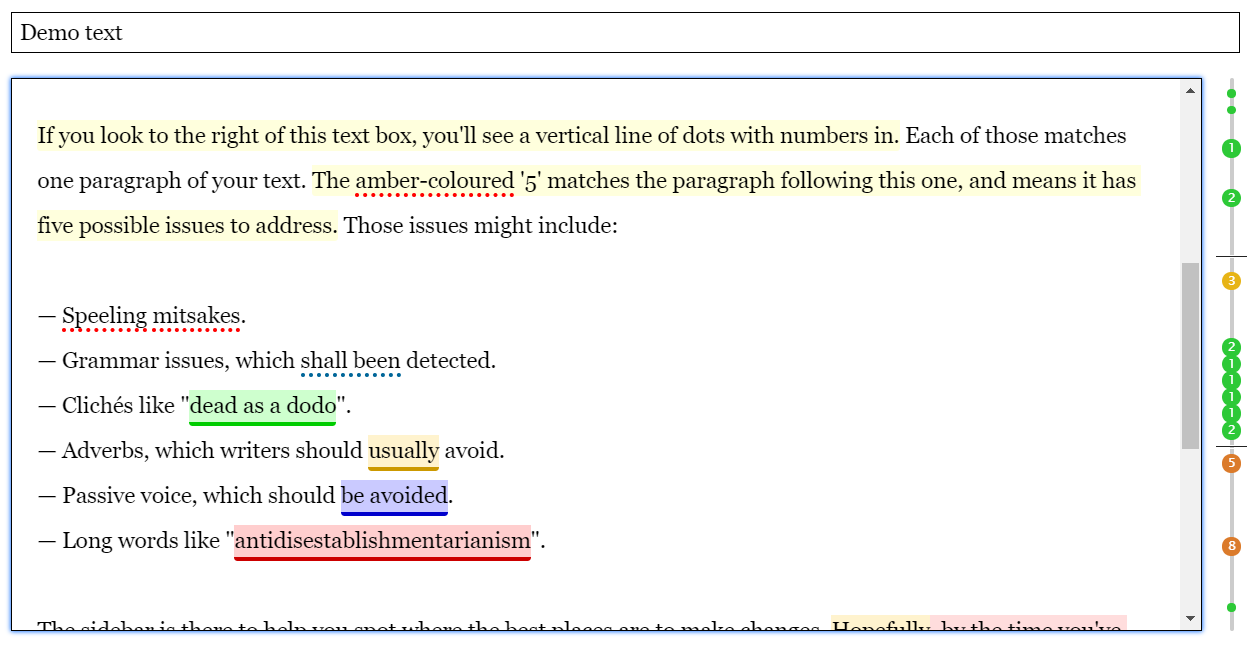
Our handy sidebar on the right of the text tool will tell you which parts of your text need the most attention, which you can click to navigate. Highlights and hover annotations will explain the issue it's highlighted and give you a suggestion of how to fix it.
There's nothing like visible progress to keep you motivated and productive - your score will update automatically as you edit.
After a few simple changes, you'll be amazed how much clearer your writing is.
File Scoring
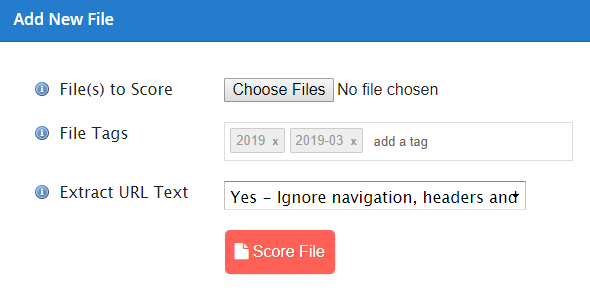
Upload your current projects and let ReadablePro get to work scoring your document within minutes.
Files you can upload include Word documents, Open Document, CSVs of texts or URLs, Markdown, PDFs, eBooks and almost any other text format in use today.
Once your report is ready, we'll email you with a link to download it. You can also find your file stored on your account where you can view and edit it anytime.
Email Scoring
Got a newsletter to check for readability or just want to check that your correspondence is clear? Feel free to send a test email to us first with our email scoring feature.
Within a few minutes, we'll email you back to say your results are ready as with your file uploads.
You'll get a link to view, but your past email scores are stored and you can access them anytime.
You'll get an overall rating for your email and on viewing the results, you'll see your scores and the details of your scoring for your HTML and plain text content.
We know how important it is to write with clarity within all aspects of your campaign. Clear, concise emails are a crucial step to writing content your audience will love.
Try it now for free! Send an email to score-my-email@readablemail.com to have it scored automatically.

Bulk Scoring
Sometimes you may find you have a lot of text or URLs to score. Don't worry, we can handle that too!
Upload a CSV (a simple spreadsheet format which you can get from Excel, Calc or any other spreadsheet application) of text or URLs (or both, combined), and we will score every item individually. Much faster than doing them one at a time!
This means you could bulk-score all the URLs from a particular section of your website that needs attention. We'll give you an overall readability score for the CSV and a score for each URL included.
Bulk URL uploading is supported on all of our plans - ContentPro, CommercePro and AgencyPro.


